Private Pilot · Free course sample
Four Forces & Steady Flight
Read a real course lesson, try three knowledge checks and explain the idea in your own words.
No account or payment needed. This sample includes the reading and selected exercises; the full course also includes its lab, audio and saved progress.
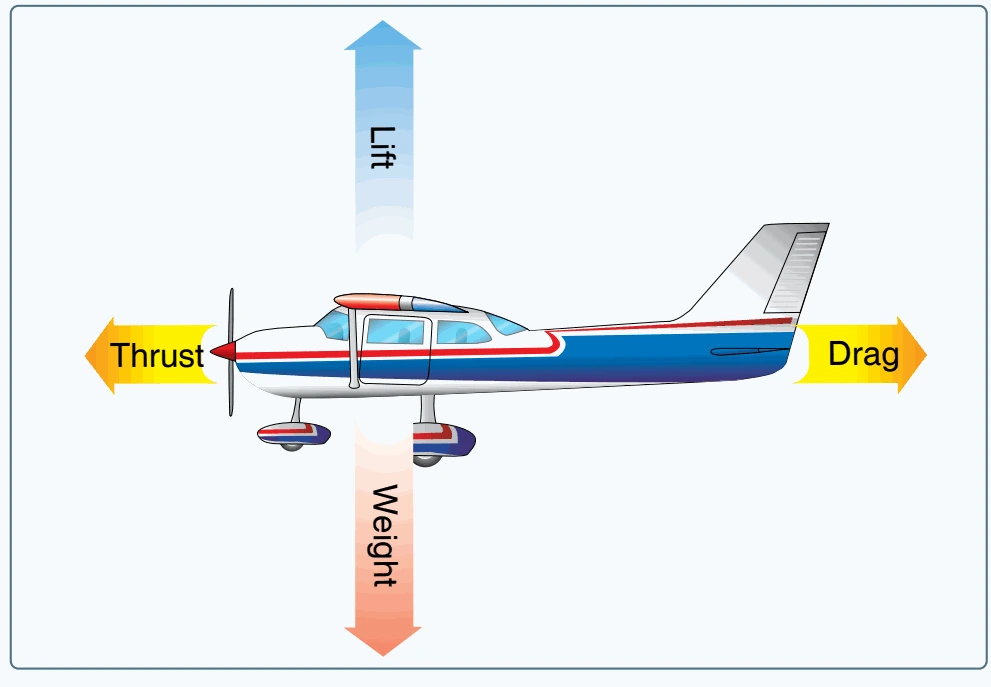
Look at an airplane in straight, level flight. Four forces are acting at the same time: lift, weight, thrust and drag. You do not compare all four together. Lift is compared with weight; thrust is compared with drag. This lesson will show where each force comes from, which way it acts and what changes when one pair no longer balances.
Read · 1 of 4
Two pairs, not four rivals
Four forces act on the airplane in flight, and they are not four rivals in one contest. They are two pairs. Lift is compared with weight. Thrust is compared with drag. That is the whole organizing idea, and everything later in aerodynamics leans on it.
Why the pairing matters
A pair is two forces acting along the same line in opposite directions. Lift and weight act vertically. Thrust and drag act along the flight path. Comparing across the pairs — lift against thrust, say — compares forces that are not opposing each other at all.
So when you look at the airplane, look twice. Once up and down. Once fore and aft. Two comparisons, made separately, and neither one tells you anything about the other.
Check your understanding
Try it before you buy.
Explain it
Put the idea into your own words.
Source: FAA Pilot’s Handbook of Aeronautical Knowledge, Chapter 5. Aircraft-specific procedures and limits come from your airplane’s AFM/POH.
Keep learning with The Pilot Method.
The Private Pilot Course includes PAR Written Prep and the Private Pilot study guide. Choose a one-time purchase or All Access.