Private Pilot · Airplane single-engine land
The Private
Pilot Course.
Your Private Pilot ground school. Learn the theory, prepare for the written and build the judgment you will use in the airplane.
One-time $199. Lifetime course access. 30-day refund — see the conditions.
Eligible students can receive the applicable instructor endorsement after completing the required course criteria and instructor review.
What you actually get
Build the knowledge.
Prepare for the test.
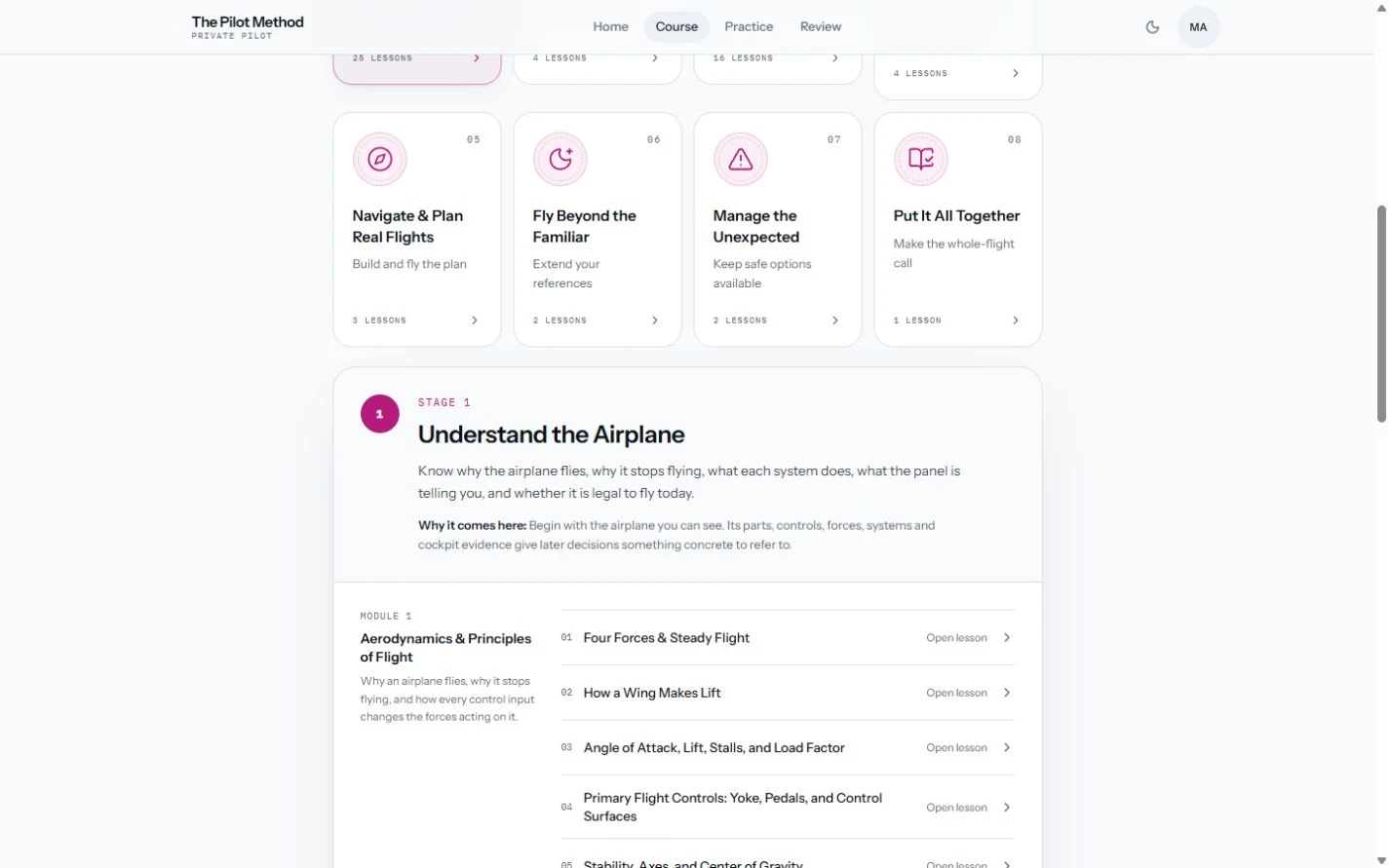
Sequenced ground lessons
The real curriculum, from understanding the airplane to making the whole-flight decision.
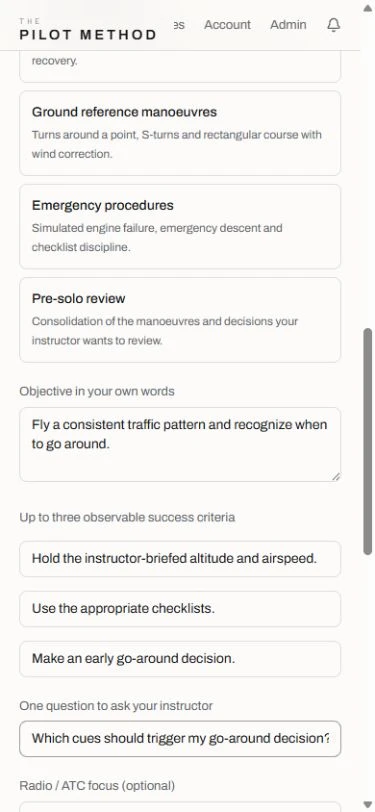
Prepare for the next flight
A focused brief before the lesson. An honest debrief after landing.
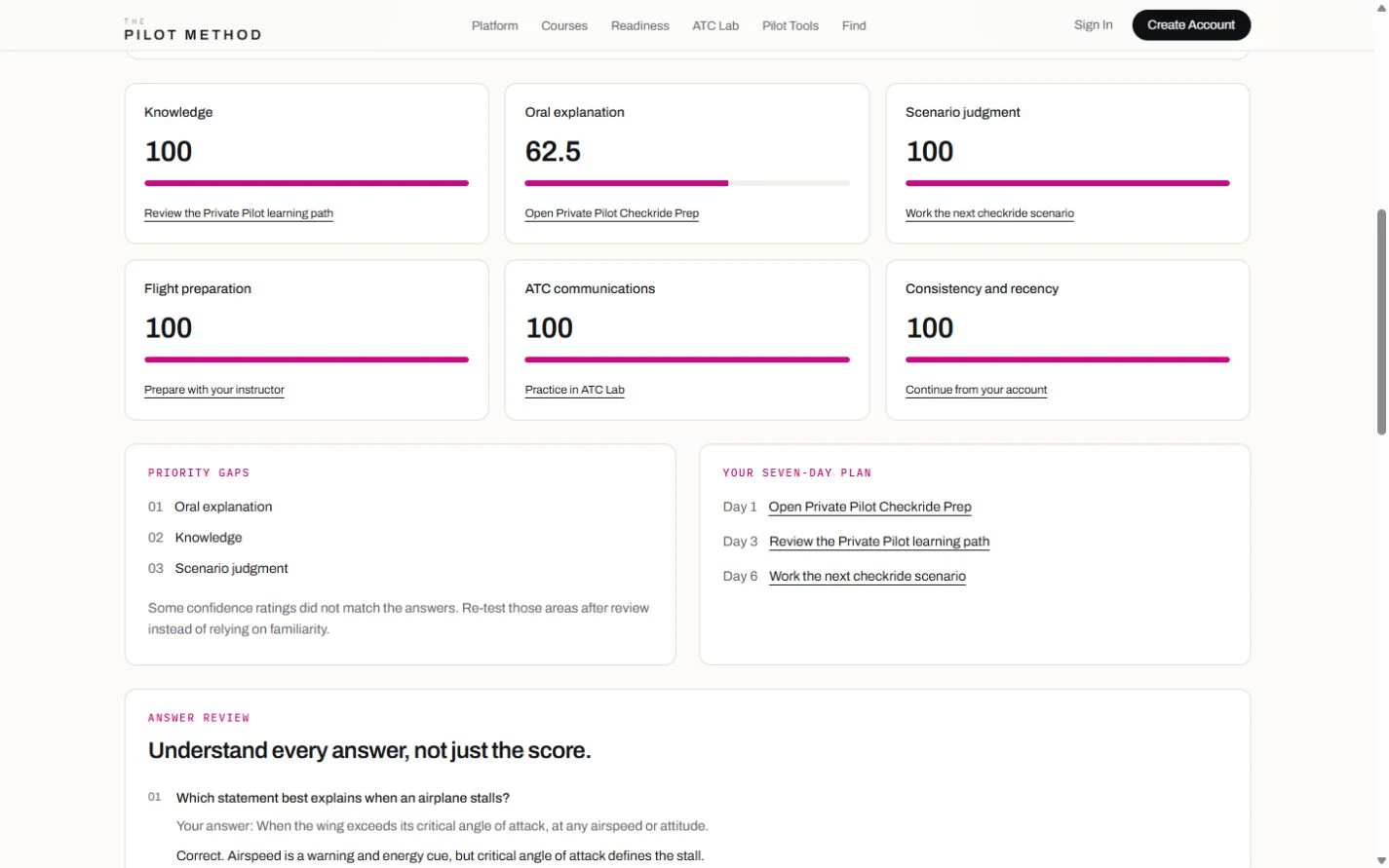
Know what to fix
Six preparation dimensions and a seven-day plan that names the weak area.
Learn in the course, practice with Written Prep and review with your study guide. Use Checkride Preparation, Flight Lesson Planner and Practice Communications to bring that knowledge into your training.
How the method works
Knowing the words
is the beginning.
Read the explanation. Say it back in your own words. Then make a decision when the situation changes.
- Read. Build the mental picture.
- Explain. Find the relationship you cannot yet describe.
- Apply. Choose an action and understand why.
The course follows a training sequence and connects the lessons to the applicable Airman Certification Standards.
Inside the course
65 lessons.
A purposeful order.
One orientation, then eight stages. Aircraft handling and care are taught along the way, from your first visit through planning and sharing the airplane. Open a stage to see its lessons.
Start here · orientation
Welcome to Your Private Pilot Journey
01Understand the Airplane27 lessons +
- Your first visit to the airplane
- Four Forces & Steady Flight
- How a Wing Makes Lift
- Angle of Attack, Lift, Stalls, and Load Factor
- Primary Flight Controls: Yoke, Pedals, and Control Surfaces
- Stability, Axes, and Center of Gravity
- How Speed Changes Drag and Power Required
- Turning, Load Factor, and Maneuvering Speed
- Coordination in a Turn
- Energy Management, Ground Effect & Wake Turbulence
- From Fuel and Air to Thrust
- Fuel System: From Tank to Engine
- How Air Reaches the Engine: Induction and Carburetor Ice
- How a Propeller Makes Thrust
- Cabin Heat, Defrost, and Carbon Monoxide
- How the Airplane's Electrical System Works
- Landing Gear, Brakes and Tires
- How the Airframe Carries Loads
- What a Changed Indication Can Tell You
- Clean the airplane without damaging it
- Pitot-Static System: Sources, Instruments, and Blockages
- Instrument Sources: What Each Indication Depends On
- Read the Panel: Speed, Altitude, Trend
- Altimetry
- Magnetic Compass, Heading Indicator, and AHRS
- Can This Airplane Fly Today?
- Inspect the Airplane, Brief Your Passengers, and Start Safely
02Understand Your Role as a Pilot6 lessons +
- Before You Act as Pilot in Command
- What Can a Private Pilot Be Paid For?
- PIC Authority, Emergency Deviations, and Reporting
- Where to Find the Official Answer
- Tell someone when you find a problem
- Know when a task needs maintenance
03Fly & Operate Locally19 lessons +
- Move the airplane safely on the ground
- Airport Surface Operations
- Know When You May Cross or Enter a Runway
- Fly the Airport Traffic Pattern
- Read the Chart
- Find the Airspace You're Actually In
- Recognize Class A Through G
- The E/G Layer
- Before You Enter
- Stay VFR
- Special Use and Other Airspace
- Fly the Route
- VFR Communications
- Prepare the airplane and the people aboard
- Right-of-Way, Minimum Altitudes, and Airspeed Limits
- Take Off, Land, and Go Around Safely
- Park, secure and leave the airplane ready
- Slow Flight, Stalls & Spin Awareness
- Steep Turns & Ground Reference Maneuvers
04Read the Day & Know the Airplane's Limits4 lessons +
- Weather Fundamentals and Hazards
- Get the Weather Briefing, Then Make the Call
- Calculate Weight & Balance for the Whole Flight
- Aircraft Performance: Takeoff, Climb & Landing
05Navigate & Plan Real Flights4 lessons +
- Navigate with the Chart, the Clock & What You See
- Build and Use a VFR Navigation Log
- Cross-Country Planning: Build a Plan That Can Change
- Share an airplane responsibly
06Fly Beyond the Familiar2 lessons +
- Basic Instrument Flying and an Accidental Entry into Cloud
- Night Operations
07Manage the Unexpected2 lessons +
- Emergencies: Fly the Airplane and Use the Right Procedure
- Human Factors: Fitness, Physiology & Good Decisions
08Put It All Together1 lesson +
- Checkride Preparation & Putting It Together
A lesson, in full
Four forces.
One useful mental model.
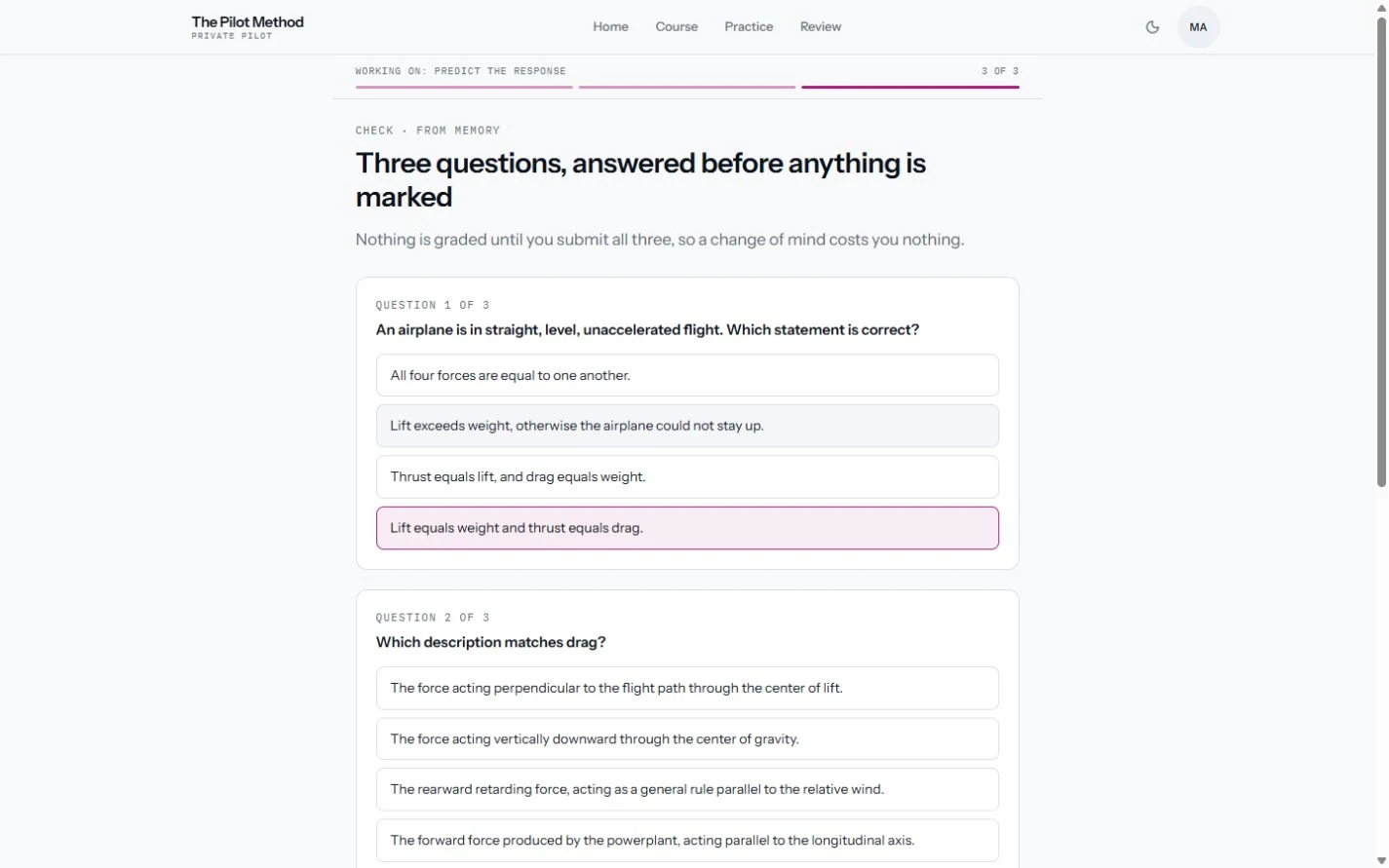
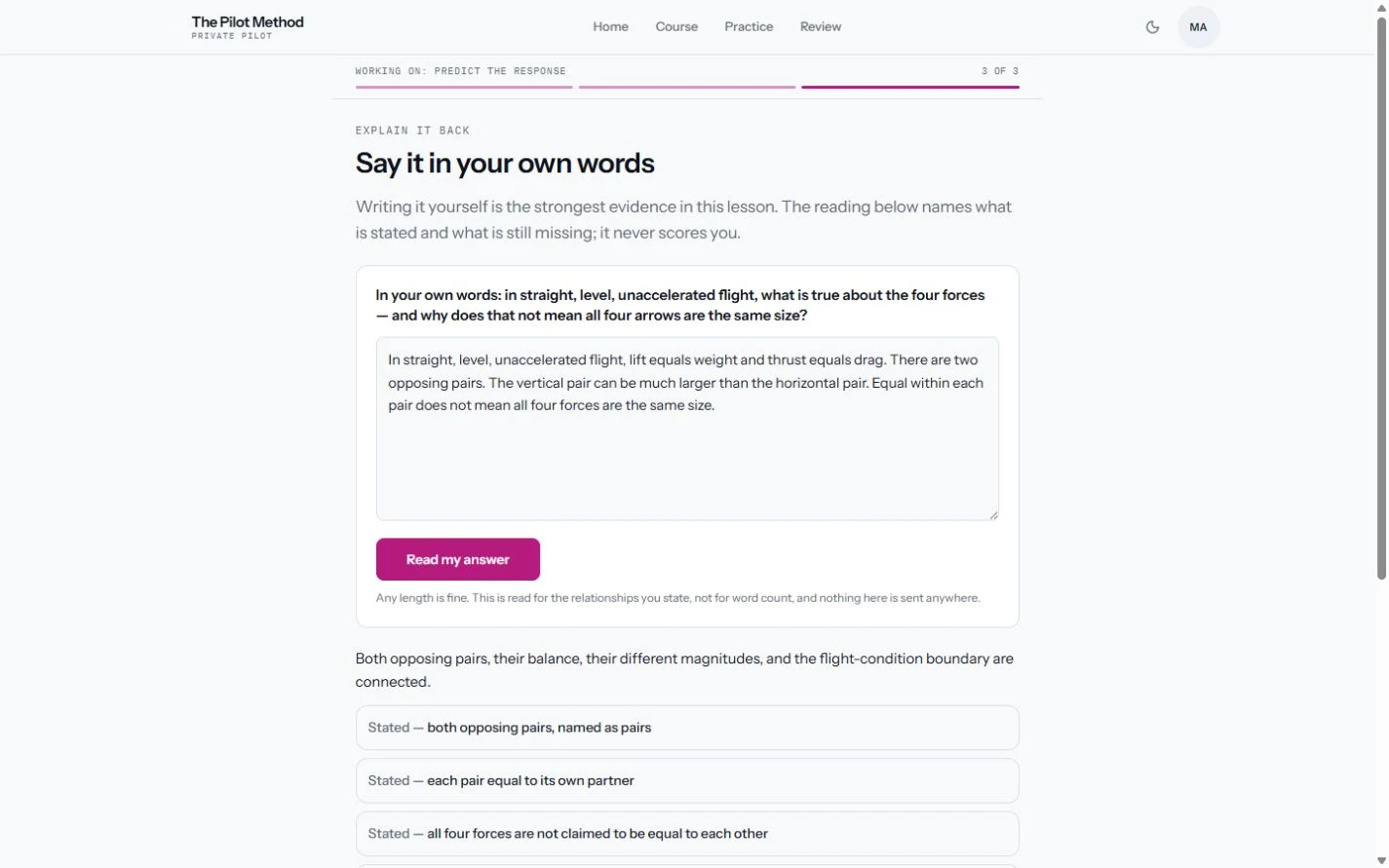
Start with lift, weight, thrust and drag. Build the two comparisons. Explain what balances in steady flight, then decide what changes when power changes. These are captures of the actual lesson and its scenario.
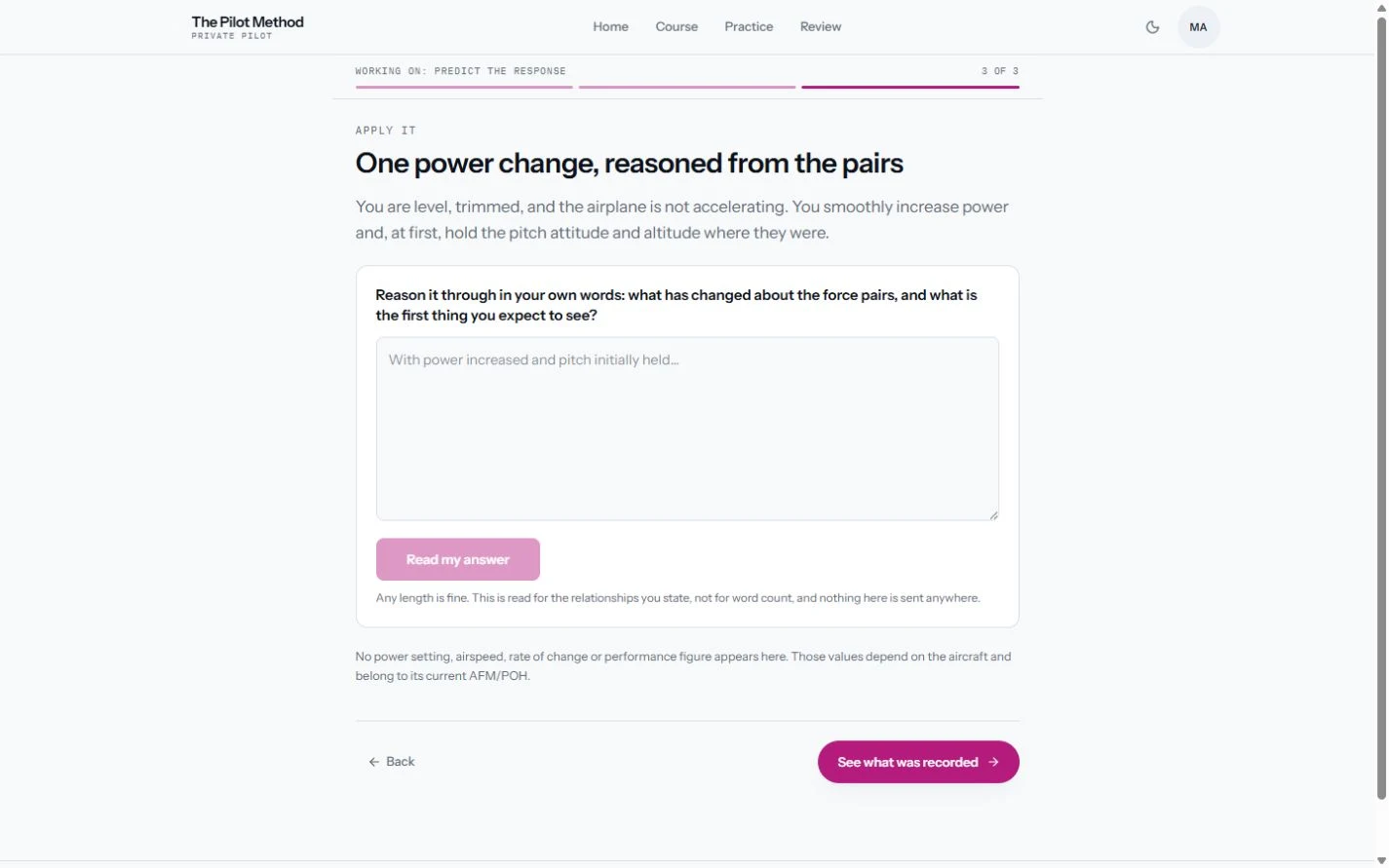
See the lesson's explain-back prompt
In your own words: in straight, level, unaccelerated flight, what is true about the four forces, and why does that not mean all four arrows are the same size?
It connects to the rest
Find the gap.
Put it to work.
Your readiness result names the weak area. Use it to choose the lesson to revisit. Practice the radio decision in Practice Communications, then carry a specific question into your next flight.
Checkride Preparation
Find the weak area.
Course
Rebuild the explanation.
Practice Communications
Rehearse the radio decision.
Next flight
Brief it with your instructor.
Who it is for
For the student
doing the work.
- Pre-solo students building the foundation.
- Students who want a clear study sequence between flights.
- Returning pilots refreshing Private Pilot knowledge.
- Career-track students taking their first certificate seriously.
Ground school with an endorsement pathway.
Complete the course, prepare for the FAA knowledge test, and work toward checkride readiness. Eligible students can receive the applicable instructor endorsement after completing the required course criteria and instructor review.
Aircraft-specific figures always come from the AFM/POH for the airplane you fly.
One-time course purchase
$199 USD
One payment. No subscription. No renewal.
Your course stays in My Training and My Library, including updates, for as long as the product exists.
Checking your course access…
A clear refund policy.
You can request a full refund within 30 calendar days of your purchase. To qualify, all of the following must also be true at the time of the request:
- your server-recorded course completion is below 80%;
- you have not submitted a request for final instructor review or for a knowledge-test endorsement; and
- no completion credential has been issued to you.
Before you start
Good questions.
Can I earn my knowledge-test endorsement here?
Yes. Complete the required course work, then request review by our authorized instructor. When the instructor confirms your preparation and eligibility, they can issue your FAA knowledge-test endorsement. Start the review through Contact The Pilot Method.
How does this fit my pilot training?
This is your online ground school for Private Pilot ASEL under the Part 61 home-study path. Learn the theory here and complete your flight training with a flight instructor. Part 61 permits home-study courses; Part 141 school approval is a different pathway.
Will it prepare me for the knowledge test?
Yes. Learn Private Pilot theory in the course and use the included PAR Written Prep to practice for the FAA knowledge test. Instructor review is the next step toward your knowledge-test endorsement.
How long does it take?
That depends on how often you fly and study. Work through the sequence with your instructor and revisit the lessons you need before each flight.
What does lifetime access mean?
One payment. No renewal. The course stays in your library, including updates, for as long as the product exists.
What if it is not for me?
You can request a full refund within 30 calendar days of purchase, subject to all three conditions listed above and in the refund policy.
Do I need an account before I buy?
Yes. Your account is where the course, progress and lifetime access are kept. Click Get the course, create or sign in to your account, and then continue securely to payment.
Which aircraft does it cover?
Airplane single-engine land, generically. Speeds, weights and limitations always come from the AFM/POH for the airplane you fly.
Sources and methodology
Covers the Private Pilot certificate, airplane single-engine land.
Complete the required course work and contact our instructor for knowledge-test endorsement review. The instructor reviews your preparation before issuing the applicable endorsement. Flight-training and practical-test endorsements follow their own training and experience requirements.
The course provides ground training through the Part 61 home-study pathway. Use the current AFM/POH for aircraft-specific figures and complete your flight instruction in the airplane you will fly.
What this course is built from
- 14 CFR Parts 61 and 91
- FAA-S-ACS-6C — Private Pilot for Airplane Category
- FAA Pilot's Handbook of Aeronautical Knowledge
- FAA Airplane Flying Handbook
- Aeronautical Information Manual
Version 1.0 · Last reviewed 2026-09-04
Ground knowledge sequenced the way instruction actually works, so what you study matches what you fly next. For people exploring flying and anyone working toward a certificate or rating.
One-time $199. Lifetime course access. 30-day refund — see the conditions.
Eligible students can receive the applicable instructor endorsement after completing the required course criteria and instructor review.